A quick estimate can differ from a figure elsewhere because market prices change and calculators may use different value settings. This guide explains how to read the PI price in USD, calculate common amounts, and use a PI-to-USD calculator. The result is an estimate of value, not a promise of what you would receive in a transaction. Start with the rate, then apply it to the amount of Pi you want to convert.
Key Takeaways
- Find the live PI-to-USD rate, then note when it was updated before using it for an estimate.
- Compare price movement across different time periods to put a short-term change in context.
- Use common conversion examples to estimate what a PI balance may be worth in US dollars.
- Enter a PI amount or USD value in a calculator and understand how the selected price basis shapes the result.
What is the current 1 PI to USD conversion rate?
Rates move with trading prices, so each figure is a time-specific reference, not a fixed conversion.
Exchange comparisons show why live quotes can vary. These are separate USD-denominated market readings, not a single universal price. Differences may reflect trading activity on each venue and the timing of quotes. Compare the trading pair and timestamp, not just the number of decimal places.
That spread shows how a displayed rate can change throughout the day. A live PI-to-USD exchange rate is most useful when it includes a recent update time and clearly identifies the value basis.
Kraken, Gate, and CEX.IO are the exchanges with listed PI prices in the supplied market snapshot. The figures above are USD quotations; they do not establish that each venue offers a PI/USDT pair.
A PI-to-USD estimate does not mean a U.S. user can withdraw or sell PI for USD. That depends on whether the exchange supports the relevant PI trading pair and USD withdrawal method for the account. Check those options in the exchange interface before treating an estimate as withdrawable cash.
- Compare the live rate with the venue’s displayed PI quote.
- Use the timestamp and trading pair to interpret differences between prices.
What is the price of Pi Network Coin in USD?
PI’s USD price changes over short and long periods, so a single quote gives only a snapshot. The market data reports a 13.86% decline over the past 30 days. That figure describes the change across the period, not the size of each daily move. A chart can show the path between dates, while a percentage summarizes the overall direction.
These figures show why a historical reference needs a clear time window. Weekly movement may tell a different story from a monthly or annual comparison, even when each uses the same asset and currency.
To read a thirty-day price change, identify the start and end dates first. Then compare the reported percentage with the corresponding prices, if the same market view provides them. The supplied market data reports a 13.86% decrease over the past 30 days. Avoid treating that result as a forecast: it describes historical movement, not what PI will do next.
Historical reference points also need context. These values refer to different periods, so they aren’t interchangeable. The all-time figure describes a broader historical peak; the 90-day figure captures a shorter window.
For a useful comparison, keep the currency and period consistent. Compare PI against USD over the same dates, and note whether a figure reflects a daily, monthly, or annual change. Read the current Pi to USD conversion alongside historical performance, rather than mistaking it for a complete picture of PI’s price movement.
To explore how a selected PI value translates into fiat, use a PI-to-USD conversion calculator and compare the result with the period you’re reviewing.
Common PI-to-USD conversion amounts
Conversion estimates use a simple calculation: multiply the PI amount by the USD value per PI. For example, a displayed conversion snapshot gives ready-reference amounts for balances ranging from 25 PI to 10,000 PI. These examples make it easier to estimate small holdings and larger totals without recalculating each figure from scratch.
Use these figures as examples from one conversion snapshot, not as permanent amounts. The PI price changes, so the same balance can produce a different USD estimate later. A calculator may retain extra decimal places before rounding, while a display may round the result to cents.
For a balance between the listed examples, use the same multiplication. First, identify the rate per PI. Multiply it by your exact balance, then read the result in USD and note the displayed decimal places. Keep the full balance during the calculation, then round the final amount for a clearer estimate.
The second amount is close to twice the first, with the small difference reflecting rounding in the displayed values. This comparison helps check the scale, but it does not replace a calculation using the rate available when you need an estimate.
Amounts such as 25, 100, or 1,000 PI are practical reference points, not separate market prices. Each conversion depends on the rate applied to the balance. To compare two balances consistently, use the same PI price, currency, and rounding approach for both calculations.
PI and USD conversion calculator
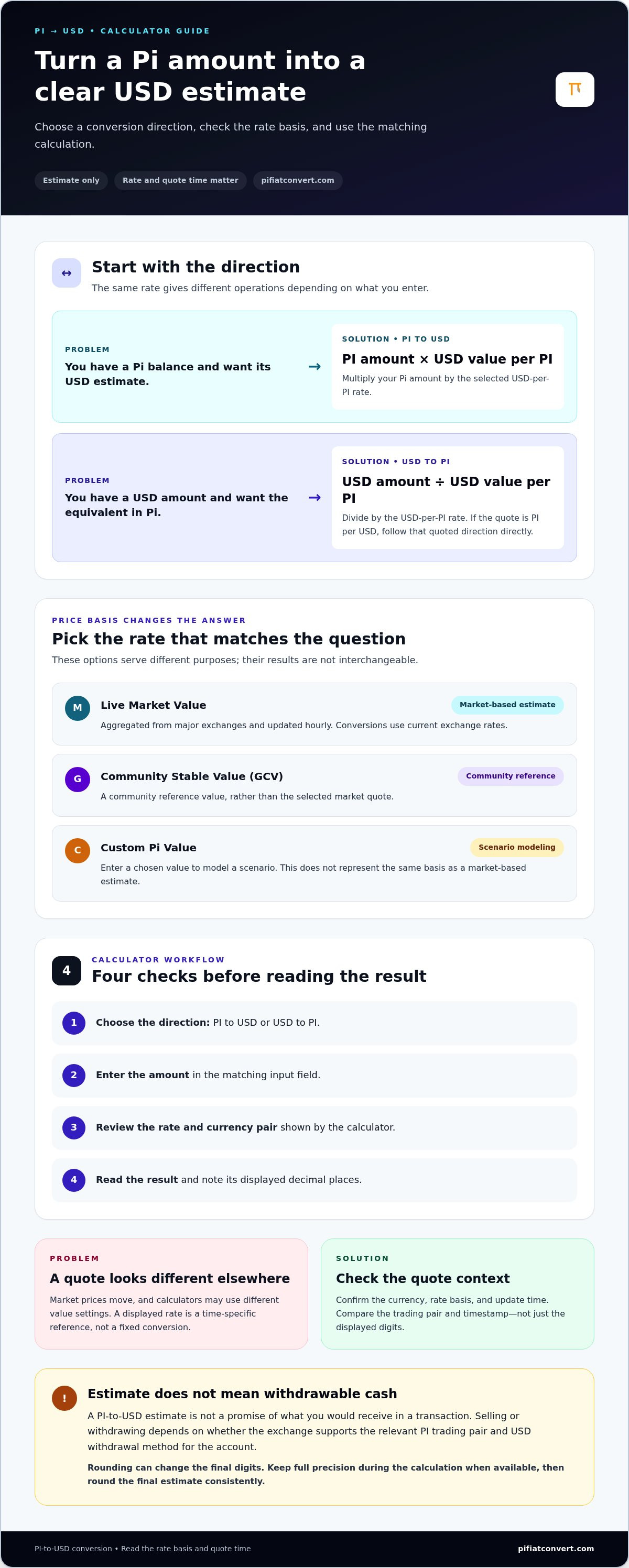
A PI-to-USD calculator applies a selected exchange rate to an amount of Pi. For a PI balance, multiply the PI amount by the USD value per PI. To convert in reverse, divide the USD amount by the USD value of one PI. The result depends on the rate and quote time used.
Follow these steps to calculate a conversion:
- Choose whether you’re converting PI to USD or USD to PI.
- Enter the amount in the matching input field.
- Review the rate and currency pair shown by the calculator.
- Read the result, including its displayed decimal places.
To enter a USD amount, divide it by the USD-per-PI rate rather than multiplying. If the calculator gives its rate as PI per USD, use that quoted direction directly. Matching the input direction to the displayed rate helps prevent basic calculation errors.
Check how the calculator identifies its price basis. A market-based rate reflects the selected market quote, while a custom rate lets you test a chosen value. These settings answer different questions: one estimates value against a market reference, while the other models a scenario. Don’t compare their outputs as if they used identical rates.
Before relying on a result, confirm that the output is in USD, not another currency, and note the rate’s timestamp. Rounding can affect the final digits because a calculator may retain more precision internally than it displays. When available, use the unrounded rate for your calculation, then round the final estimate consistently.
Use a PI-to-USD calculator to enter a balance, select the conversion direction, and review the resulting estimate against its stated rate basis.
Pi Converter: Pi Converter
Pi Converter converts Pi into USD and other fiat currencies using your selected value basis. Choose live Market Value for a market-based estimate, community Stable Value (GCV) for a community reference, or a custom Pi value to model a scenario. Each option answers a different question, so choose the basis that fits your estimate.
For a current PI-to-USD estimate, enter the amount and review the conversion. Market Value is aggregated from major exchanges and updated hourly, and conversions use current exchange rates. The calculator estimates value; it is not an exchange, brokerage, wallet, custody, or mining service.
Use Pi Converter to calculate a PI-to-USD estimate with your preferred value basis.
Make Your Next PI Valuation More Useful
Use a PI valuation to support a specific decision, such as tracking a balance, comparing scenarios, or keeping personal records. Note your chosen value basis and calculation time to make later comparisons more meaningful. This also helps distinguish changes in PI’s market price from changes in the assumptions behind your estimate.
For a current Pi to USD conversion that fits your purpose, choose your rate approach deliberately and use a consistent calculation method when reviewing it again. Treat the result as a reference for evaluating value, not a substitute for your own financial judgment.
Pi Converter offers a tool for converting Pi into fiat currencies. If you want to run your own estimate, use Pi Converter and explore the value basis that suits your calculation. A clear method makes your next PI review easier to interpret.
Frequently Asked Questions
Is it a good time to exchange 1 PI to USD?
Whether to exchange 1 PI depends on your purpose, not the quoted rate alone. Compare the value available now with your own holding plans and the amount you would need in USD. A market price shows a valuation at a point in time; it doesn’t determine whether exchanging suits your circumstances. Consider the relevant trading pair and withdrawal method before treating a quote as cash you can access.
What does the 1 PI to USD rate mean?
The 1 PI to USD rate expresses the value of one Pi Network Coin in United States dollars at a particular time. It’s a unit conversion reference, not a guarantee that a transaction will settle at precisely that amount.
What is the current Pi Network (PI) price in USD?
Treat that figure as a dated reading, not a permanent price, because market quotes change. When comparing figures, make sure they refer to the same currency and similar timestamps. Different snapshots can show different values even when they use the same units.
What is the PI to USD conversion rate right now?
A live quote may move after that snapshot, so a calculator can show a different rate. Check its update time and the direction of the pair: PI to USD gives dollars per Pi, while USD to PI gives Pi per dollar.
How much is 1 PI worth in USD?
To estimate another amount, multiply the PI amount by the displayed USD-per-PI rate. The same calculation applies to a fractional holding as to a whole-coin amount. Read the result as a market-value estimate and note the quote time used.
How much is 10 PI worth in USD?
The precise display can differ because of the rate timestamp and rounding method. For your balance, use the calculator’s current rate rather than carrying this example forward, and retain the displayed precision when comparing estimates.