A Pi conversion estimate from the arctan series depends on how many terms are included: the first two terms give 2.6667, while adding terms moves the estimate closer to π. A useful reference is 3.141592654, and π lies between 3.1415926 and 3.1415927. More terms can improve precision, but the series converges slowly.
A longer calculation does not automatically produce a reliable decimal. The method matters too: some algorithms converge faster than others, while rational approximations and bounds offer different ways to show how close an estimate is to π.
This article explains how the arctan series builds an estimate term by term, why the number of terms affects accuracy, and how rational approximations compare with bounds. It also covers what an estimate can tell you, its limitations, and how to interpret a calculated value without mistaking a useful approximation for the exact constant.
Key Takeaways
- See why adding terms to an alternating series improves an estimate, while the choice of algorithm affects how quickly precision increases.
- Compare rational approximations with decimal estimates and understand what each representation can reveal about π.
- Use upper and lower bounds to express a range for π rather than relying on a single rounded value.
- Distinguish mathematical estimates of π from Pi Network conversion values, which depend on the selected valuation basis and currency exchange rates.
Estimating pi with different numbers of series terms
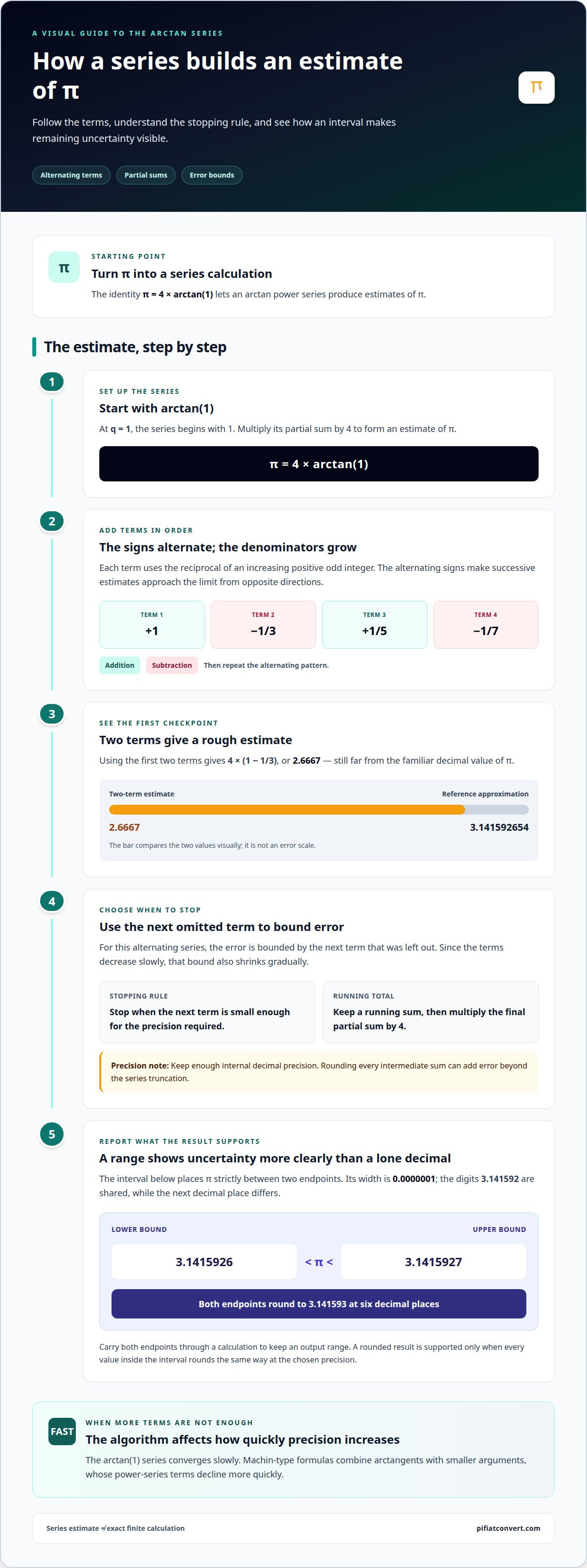
The identity π = 4 × arctan(1) turns pi estimation into a series calculation. At q = 1, the arctan power series alternates, beginning with 1 and subtracting 1/3, then adding 1/5 and subtracting 1/7. Multiplying its partial sum by 4 produces an estimate of π. The first two terms give 4 × (1 − 1/3), or 2.6667, which is still far from the familiar decimal value.
Each additional term adjusts the partial sum, and alternating signs make successive estimates approach the limit from opposite directions. Because the terms use reciprocals of increasing positive odd integers, they decrease slowly. The alternating-series rule bounds the error by the next omitted term. That bound is useful, but it shrinks gradually for this series.
A simple implementation tracks a running total. Start with total = 0; for each term index k, add (−1)k divided by (2k + 1), then multiply the final total by 4. Choose a stopping condition based on the next term’s size or the precision required. Keep enough internal decimal precision: rounding every intermediate sum can introduce extra error beyond the series truncation.
Infinite series describe π through a limit, not a finite list of completed operations. A computer always calculates a partial sum, so the term count and stopping rule determine the practical estimate. Faster-converging approaches reduce this computational bottleneck. Machin-type formulas combine arctangents with smaller arguments, whose power-series terms decline more quickly than terms from arctan(1).
What affects a Pi Coin conversion estimate? The valuation basis matters: community Stable Value, Market Value, or a custom Pi value can produce different results. The selected fiat currency and its current exchange rate also affect the converted amount. Market Value data aggregated from major exchanges is updated hourly.
These are separate calculations. A series estimates the mathematical constant π; a Pi Coin conversion applies a selected Pi valuation and currency rate. The number of terms improves the former, but does not determine the latter.
Historical rational approximations
Rational approximations express π as a ratio of whole numbers, p/q, rather than as an indefinitely continuing decimal. They are useful when a calculation needs a compact fraction or finite representation. Historically, these approximations offered a practical way to work with circles before decimal computation became routine. Their quality depends on how closely the numerator and denominator capture π, not simply on how large either number is.
Continued fractions provide a systematic way to find rational approximations. The process repeatedly separates a number into its integer part and the reciprocal of its remaining fractional part. Truncating the expansion produces convergents, each a fraction p/q that approximates the original value. A later convergent generally fits more closely, though its numerator and denominator may be less convenient for mental arithmetic or simple calculations.
For comparison, 3.141592654 is a useful decimal approximation of π. Its digits communicate precision directly, while a rational form can be easier to manipulate in exact arithmetic. Neither format is automatically best: a short fraction is convenient but may be coarse, and a long decimal can imply more precision than a calculation needs. Match the representation to the task, such as measurement, geometry, or numerical computation.
Track approximation error by comparing the chosen value with a reliable interval or a higher-precision reference. The listed bounds, 3.1415926<π<3.1415927, show that 3.141592654 falls inside a narrow range. More decimal places alone don’t establish accuracy; the reference and rounding method matter. In a calculation, the effect of error also depends on how the approximation is used.
What are the risks of relying on Pi conversion estimates? A mathematical approximation of π doesn’t establish Pi Coin’s fiat value, and a conversion estimate can vary with its chosen valuation basis and exchange rate. Treat the two calculations as separate. For a Pi Coin amount expressed in fiat, use a Pi-to-fiat conversion tool and interpret its result as a currency estimate, not as a more precise value of π.
Bounds on pi
A bound describes a range that contains π, rather than presenting one decimal as exact. Here, 3.1415926<π<3.1415927 places the constant strictly between two endpoints. The inequality signs matter: π is greater than the lower endpoint and less than the upper one. This gives a defined interval for reasoning, even when a calculation doesn’t require more digits.
The interval’s width is 0.0000001, found by subtracting 3.1415926 from 3.1415927. Both endpoints share the digits 3.141592, so those digits are stable within this range. The next decimal place differs. That distinction helps separate shared precision from digits the interval alone cannot settle.
To use a bound, carry both endpoints through the calculation. For example, if a formula multiplies π by a positive quantity, multiply each endpoint by that quantity. The resulting lower and upper values enclose the output. If an operation changes direction, such as division by a negative quantity, reverse the endpoint order.
Rounding requires a separate decision. The interval supports a rounded result only when every value inside it rounds the same way at the chosen precision. For instance, both endpoints round to 3.141593 at six decimal places under ordinary rounding. If the desired precision distinguishes values within the interval, a tighter bound is needed before reporting that digit confidently.
Bounds make error visible. A single estimate can obscure whether its final digits are justified, while an interval shows the remaining uncertainty directly. Compare the estimate with both endpoints, then decide whether the interval is narrow enough for the task. Geometry may tolerate a broader range than a numerical calculation that depends heavily on small differences.
How is Pi Network's conversion rate estimated?
A Pi conversion estimate starts with a selected value for one Pi, then converts that value into a chosen fiat currency. It is not calculated from the mathematical constant π. The estimate depends on the valuation basis: community Stable Value, Market Value, or a custom Pi value. Because these inputs differ, the same Pi amount can produce different fiat estimates.
With Market Value, the displayed Pi value is aggregated from major exchanges and updated hourly. The conversion applies current exchange rates to express the result in another currency. For example, choosing USD rather than EUR changes the currency used for the estimate. The displayed amount reflects both the selected Pi valuation and the currency conversion rate, not a series approximation of π.
Stable Value, also called GCV, represents a community valuation basis. A custom Pi value lets you choose a value instead. These settings answer different questions: Market Value uses exchange data, Stable Value applies the community’s chosen reference, and a custom value tests a user-defined assumption. State which basis you used when comparing estimates, or the figures may appear inconsistent.
To interpret a result, identify the Pi amount, valuation basis, and target currency. Then distinguish the estimate from a trade: a currency conversion calculation expresses an amount using selected values and rates; it doesn’t execute an exchange. Supported currency examples include USD, EUR, GBP, NGN, and KES, alongside more than 100 other currencies. A conversion estimate is useful for comparison, but its meaning depends on those selected inputs.
For a practical calculation, estimate a Pi-to-fiat amount using the valuation basis and currency that match your comparison. Reviewing those inputs alongside the result makes it easier to understand why a different setting can produce another figure, without confusing a conversion estimate with π’s mathematical value.
Pi Converter: Pi Converter
Pi Converter is a free online tool for estimating Pi Coin amounts in fiat currencies. Use it to compare a Pi amount under a selected valuation basis, rather than to calculate mathematical π or execute a trade. Choose a basis, enter an amount, and select a currency. The result reflects those inputs and current exchange rates.
The available bases include community Stable Value (GCV), Market Value, and a custom Pi value. Estimates can differ when the selected basis changes, so keep it consistent when comparing results. Pi Converter provides conversion estimates, not Pi Coin exchange or brokerage, wallet custody, or mining.
For a practical fiat calculation, visit Pi Converter.
Make the next calculation decision-ready
Precision is useful only when it suits the decision at hand. Before relying on a calculated value, identify what it represents and which assumptions shaped it. A Pi conversion estimate concerns a selected Pi valuation and fiat currency; it is distinct from calculating the constant π. Keeping that distinction clear makes comparisons easier to interpret and prevents mathematical precision from being mistaken for certainty about an asset’s value.
For future calculations, record the valuation basis and currency alongside the result. This makes it easier to revisit an estimate when inputs change, compare like with like, and explain how you reached a figure. The goal is not to make every estimate definitive, but to make its basis clear enough to inform the next decision.
When you’re ready to calculate a Pi Coin amount in fiat, Contact Pi Converter. Use the result as a clear reference point for your next comparison.
Frequently Asked Questions
What does Pi conversion mean?
Pi conversion means expressing a Pi Coin amount in a fiat currency, such as USD or EUR, using a selected Pi value and currency rate. For a personal budget, enter the Pi amount you want to assess and note the currency and valuation basis. The result is a reference for comparing values, not confirmation that the amount can be exchanged at that rate.