A Pi GCV to USD estimate can be mathematically accurate while still differing from the price available in a live market. GCV is a community Stable Value reference, while a market-based conversion uses PI’s current exchange value. The result depends on the rate basis selected in the calculator. Treat the figure as an estimate based on that rate, not a guaranteed trading price.
That distinction matters when comparing a community valuation with a market quote or calculating what a PI amount represents in dollars. This guide explains how a calculator produces an estimate, why rates can vary, and how fiat currencies and PI trading pairs fit into the comparison. A USD conversion is useful for reference, but it does not establish the price at which a transaction can be completed.
Key Takeaways
- Identify whether a conversion uses a community reference value, a live market rate, or a custom value before interpreting the dollar estimate.
- Compare the rate’s source and update timing to understand why calculator results can differ from executable market prices.
- Review PI trading pairs and market liquidity to see how trading access can affect the quoted conversion.
- Use a currency converter to compare PI estimates across supported fiat currencies without treating the calculation as an exchange or brokerage transaction.
How accurate is the Pi Network to US Dollar calculator?
A calculator’s accuracy depends on the selected value: community Stable Value (GCV), live Market Value, or a custom Pi value.
Live and Global Pi Conversions
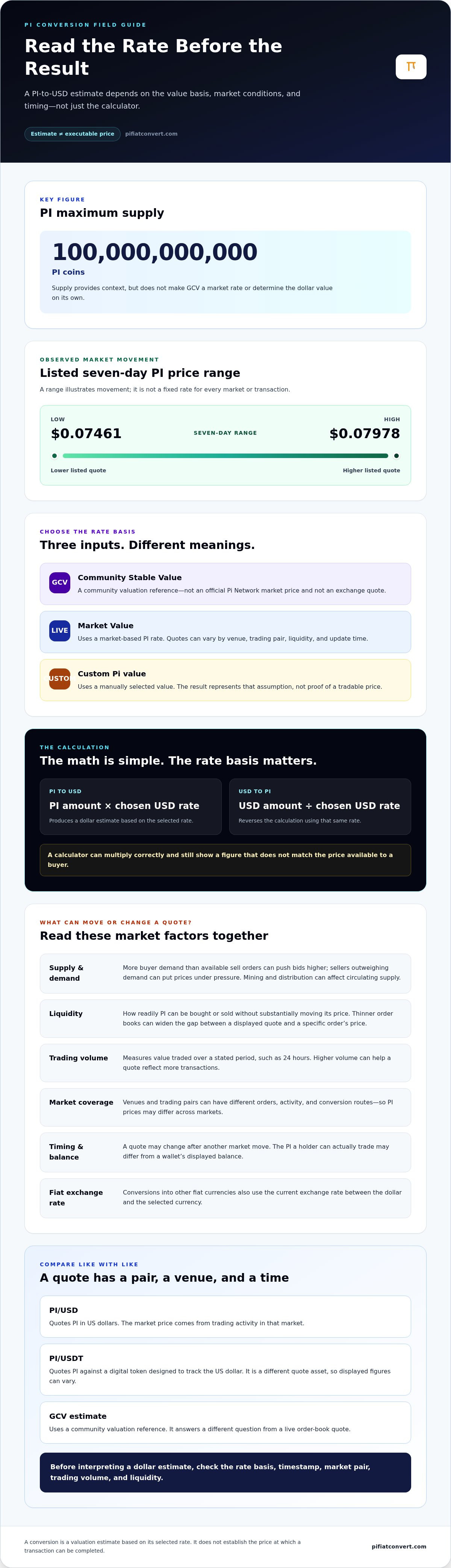
A conversion applies the selected PI rate to an amount, while a global conversion changes the fiat currency used for the result. To convert PI to USD, multiply the PI amount by the chosen USD rate; to reverse the calculation, divide the USD amount by that rate. A Pi GCV to USD estimate uses the selected community value. For other currencies, the calculator combines the chosen PI value with current exchange rates. Compare the rate basis before comparing results.
Pi GCV Definition and Status
Pi GCV, or Global Consensus Value, is a community Stable Value reference for valuing Pi. It is a community valuation, not an official Pi Network market price. The figure provides an input for calculation; it does not establish the price available through PI trading. A calculator using GCV therefore answers a different question from one using a live market quote. Keep the value basis clear when comparing estimates across the decentralized ecosystem.
Risks of Valuing Pi with GCV
GCV valuation risk is the possibility that a community reference won’t match an executable market price. A calculator can multiply correctly and still produce an estimate that doesn’t reflect trading volume, liquidity, or a particular market’s quote. Treat the output as a valuation reference, not evidence of what a buyer will pay. Pi’s maximum supply is 100,000,000,000 PI coins, but supply figures and mining discussions don’t make GCV a market rate. Separate the calculation method from the price assumption before using the result.
Factors affecting the PI/USD rate
The PI/USD rate is the market price of Pi Network’s PI asset measured in US dollars. It shifts as buyers and sellers place orders, so a calculator’s result reflects its selected rate source and update time. A quote captured now may differ after another market move.
Supply is the PI available in circulation, while demand reflects buyers’ willingness to acquire it. Circulating supply provides context, but it does not alone determine the dollar value. If demand rises faster than available sell orders, buyers may bid higher; if sellers outweigh demand, prices can fall. Mining and distribution can matter through their effect on circulating supply.
Liquidity is how readily an asset can be bought or sold without substantially moving its price. Trading volume measures the value traded over a stated period, such as 24 hours. Higher volume can help a quote reflect more transactions, while thinner order books can widen the gap between a displayed price and the price available for a specific order.
Market coverage is the set of venues and trading pairs contributing to a quote. PI can show different dollar prices across markets because each venue has its own orders, activity, and conversion route. For context, a listed seven-day range was $0.07461 to $0.07978. That range illustrates movement, not a fixed rate for every market or transaction.
A tradable balance is the PI a holder can actually use in a transaction, which may differ from a wallet’s displayed balance. Before converting PI to a dollar estimate, identify the rate basis, timestamp, and market pair. Then compare the result with trading volume and liquidity. A wallet balance or headline Pi Network price alone does not establish an executable quote.
Currency conversion adds another variable: the exchange rate between the dollar and the selected fiat currency. To compare amounts across currencies, use the same PI valuation basis and note that each fiat conversion uses its own current exchange rate. A Pi-to-fiat conversion tool can help calculate those estimates side by side.
PI exchange markets and trading pairs
An exchange is a venue where buyers and sellers trade assets under its market rules. A trading pair shows which asset is priced against another, such as PI/USD, where PI is quoted in US dollars. PI’s exchange market price comes from trading activity; GCV is a community valuation reference, not an exchange quote.
Market capitalization is an estimate of an asset’s market value, commonly calculated from its price and circulating supply. It offers scale, but it doesn’t show how much PI can be sold at a particular price. Reported 24-hour trading volume can vary across listings and over time. Volume indicates activity across the measured market, while the pair and order book determine the immediate quote.
For a PI/USD pair, the quoted price expresses the dollar value assigned to one PI in that market. A PI/USDT pair quotes PI against a digital token designed to track the US dollar. These are different quote assets, so displayed figures can vary by pair, venue, liquidity, and timing. A pair’s label does not prove that every wallet balance can be traded through it.
Exchange verification is the process a platform uses to establish account access or identity. It can affect access to trading functions, while mobile access means using an exchange through a phone or app. Neither verification nor mobile display changes PI’s underlying valuation; they concern access and presentation.
To interpret a quote, identify the pair, venue, and time shown. Then distinguish spot trading, which exchanges the underlying tokens, from derivatives, which track prices through contracts. Market figures may aggregate activity across venues, so they can differ from an executable order on one exchange. A global market view provides useful context, but local availability and trading conditions depend on the specific platform and pair. Compare like with like: PI/USD against PI/USD, not a GCV estimate against a live order-book quote.
Currency pairs and supported fiat currencies
A currency pair expresses one asset’s value in another currency, while fiat currencies are government-issued money such as the US dollar. PI/USD quotes PI against dollars; PI/EUR quotes it against euros. A fiat conversion estimate and an exchange trading pair are related, but they are not the same.
Supported fiat currencies are the currencies a converter can use to display an estimated value. Pi conversions can be calculated in USD, EUR, GBP, NGN, KES, and 100+ other currencies. Choose PI as the input asset, enter an amount, then select the output currency. For example, converting the same PI amount into USD and GBP produces separate estimates.
An exchange rate is the value used to convert one currency into another. A live PI market value can be combined with current fiat exchange rates to calculate a cross-currency estimate. Pi Converter’s Market Value aggregates data from major exchanges and updates hourly. This rate basis differs from a GCV or custom PI value, even when both produce a result in dollars.
Circulating supply means tokens available in circulation, while total supply includes tokens beyond that measure. Supply can inform market analysis, but it doesn’t determine which fiat currencies a calculator supports. Likewise, a quote covering the last 24 hours describes a time window, not a currency pair or a guaranteed conversion amount.
Pi Network’s open mainnet launched in February 2025, but a mainnet launch doesn’t mean every fiat currency has a direct PI trading pair. Currency conversion can use an estimated PI value and a fiat exchange rate without demonstrating a direct market for that combination. Identity verification, where required by a trading venue, concerns account access rather than the calculation itself.
Compare estimates in the fiat currencies relevant to your planning, and keep the rate basis consistent. Convert PI into supported fiat currencies to view values across different currency options.
Pi Converter: Pi Converter
Pi Converter is an online tool for estimating Pi Coin values in fiat currencies. Use it to compare community Stable Value (GCV), live Market Value, or a custom PI value, while keeping in mind that the result is not an exchange transaction.
Enter an amount and select a fiat currency to calculate an estimate. Supported options include USD, EUR, GBP, NGN, KES, and 100+ other currencies. Its live Market Value aggregates prices from major exchanges and updates hourly, while fiat conversions use current exchange rates. The selected rate basis matters: a GCV estimate and a market-based result answer different valuation questions.
Visit Pi Converter to calculate a PI-to-fiat estimate.
Make your next valuation more useful
Before using a Pi GCV to USD estimate to inform a decision, decide what the figure should represent. A community benchmark can help frame an internal comparison, while a market-based estimate serves a different purpose. Keeping that distinction clear in your notes makes later comparisons easier to interpret, especially when you revisit an estimate after market conditions or assumptions have changed.
Choose the valuation basis that matches your task, then use the same basis when comparing PI amounts or fiat currencies. For your next calculation, Pi Converter estimates PI values in fiat currencies using GCV, live Market Value, or a custom PI value.
Ask Pi Converter about Pi to USD and take your next step with a clearer valuation reference.
Frequently Asked Questions
Is the Pi Network price in US Dollar updated in real time?
Not tick by tick: Pi Converter’s live Market Value aggregates data from major exchanges and updates hourly. A fast market move may occur between updates, so the displayed estimate can differ from a later quote. For a time-sensitive comparison, note the calculator’s rate basis and update timing, then compare them with the quote shown for the relevant trading pair.
What is the current Pi Network to US Dollar equivalence?
Treat that as a market-rate snapshot, not a fixed equivalence. For example, multiplying your PI balance by the per-coin estimate gives a rough dollar value; the result changes when the underlying market quote changes.
What is the current Pi GCV value in USD?
There is no universal USD figure inherent in GCV. It is a community Stable Value input, so the dollar estimate depends on the GCV value selected and the amount of PI entered. A Pi GCV to USD result describes that chosen valuation scenario, not an exchange’s live bid or an agreed sale price.
How is Pi GCV converted to USD?
Multiply the selected GCV value per PI by the PI amount to calculate the USD estimate. For example, enter a PI quantity and the calculator applies the chosen value to each coin and totals the result. Before comparing calculations, check that the input uses GCV rather than Market Value or a custom PI value.
Can Pi Network coins be bought or sold at the GCV rate?
GCV alone does not set an executable buy or sell price. A transaction depends on the prices and available orders at the specific venue where PI is traded. If a market order matches at a price corresponding to GCV, that reflects the venue’s orders at that moment, not a guarantee attached to the community valuation.
Which exchanges list Pi and what are their current USD prices?
Listings and quotes depend on the exchange and trading pair, and prices change with market activity. To compare exchange quotes, read the PI/USD pair, displayed timestamp, and order price together; do not treat an aggregate estimate as a venue quote.