To estimate a conversion, multiply the PI amount by the rate. Because the rate changes, the yen equivalent can vary between snapshots.
A single figure may look straightforward, but the result depends on the PI value and exchange-rate snapshot used. This guide explains the PI-to-JPY calculation, shows conversions in both directions, and outlines why displayed values can differ as prices move. You’ll also learn how a rate translates into Japanese yen, making it easier to understand the arithmetic behind a conversion estimate.
Key Takeaways
- Understand why exchange prices can differ and how liquidity affects the rate used in a conversion.
- See how sample PI and yen amounts translate in both directions, and use the examples to interpret your own estimate.
- Learn what market inputs shape the displayed conversion and why the quoted value can change over time.
- Use Pi Converter to compare PI values in Japanese yen when you need a current conversion estimate.
How does a PI-to-JPY conversion service calculate the price?
A PI/JPY exchange rate is the yen value of one PI at a specific moment. It changes as the market quote moves.
Exchange coverage means the venues where PI can be traded and the currency pairs they support. PI was traded across 17 cryptocurrency exchanges, but a PI listing alone doesn’t establish that an exchange offers a direct JPY pair. Which exchanges list PI and provide a JPY trading pair? The available market facts don’t name specific venues or confirm individual PI/JPY pairs, so a venue’s displayed markets determine whether that direct pair is available.
Liquidity describes how readily an asset can be bought or sold without a large price effect. A deeper order book can absorb trades more easily, while limited liquidity can make individual orders move the quoted price. In normal conditions, PI prices differed by about 0.1% to 0.5% between exchanges. That spread matters because a conversion using one venue’s quote may not match another’s.
A PI/JPY price chart shows how the yen value changes over selected time intervals. Read the range alongside the percentage change for context: the percentage summarizes the movement, while the range shows the period’s recorded high and low.
The monthly trend is the direction of PI’s yen value over the previous 30 days. That rate had fallen 25.00% over the previous 30 days, while its previous-week decline was 11.00%. These figures describe different windows, so they shouldn’t be treated as interchangeable. Derivatives can influence expectations around cryptocurrencies, while bitcoin’s movements may form wider market context; neither alone defines a PI/JPY quote. Consult the chart’s time range and exchange pair to interpret the figure being used.
PI-to-JPY conversion examples
A PI-to-JPY conversion multiplies the PI amount by the yen conversion rate. Each result is a separate estimate, so treat it as an illustration rather than a fixed quote.
A JPY-to-PI conversion divides the yen amount by the PI price in yen. This reverse calculation is useful when you start with a yen amount and want to estimate its equivalent in PI.
A conversion rate is the price relationship used to translate one currency into another. Rounded displays may differ slightly from calculations using more decimal places.
A live conversion rate is a market-linked quote that can change as PI prices move. Check the rate’s time context before comparing estimates: a calculation based on one snapshot may differ from a later one. PI conversions are also available in currencies including USD, EUR, GBP, NGN and KES, with more than 100 other currencies supported.
A conversion estimate is an arithmetic result; a completed trade may involve separate execution conditions. Platform fees, spreads, and processing terms depend on the transaction route, and the examples above do not establish any fee amount. The displayed value can help estimate an equivalent, but it does not determine the final amount received in a trade.
For a current calculation, use the PI-to-JPY conversion tool and enter the amount you want to compare. This is useful when you need a yen estimate for a specific PI balance rather than relying on an older example.
Current Pi Network to Japanese yen exchange rate
The Pi Network-to-yen exchange rate expresses the value of one PI in Japanese yen. The Pi to JPY Japanese Yen rate is most useful when considered alongside its date and quote context.
Current Pi Network-Yen Quote
A current Pi Network-to-yen quote is the latest available price for converting PI into JPY. Reciprocal figures describe the same price relationship in opposite directions, though rounding can make displayed conversions look slightly different. The Pi to JPY Japanese Yen rate provides a reference for interpreting those equivalent amounts.
Live PI-JPY Quote
A live PI-JPY quote is a market price that can change as trading updates the value of PI against the yen. The 24-hour movement was a 6.31% decline as of 2026-11-17 at 02:39 (UTC), while the price had increased by 2.1% over the hour before the displayed quote. Different time windows can therefore show contrasting movements, even around the same displayed quote.
Recent dated prices show how the network’s yen valuation has changed.
To convert PI into yen, multiply the PI amount by the quote for the relevant snapshot. To convert yen into PI, divide the yen amount by the PI price. Use the calculation in the correct direction, and choose a quote for the currency pair you’re assessing.
A rate is useful only when you know its timestamp and currency pair. A PI price quoted against another currency is not automatically the same as a direct PI/JPY quote. Check the pair and quote time before using the figure to interpret a balance or compare market movements.
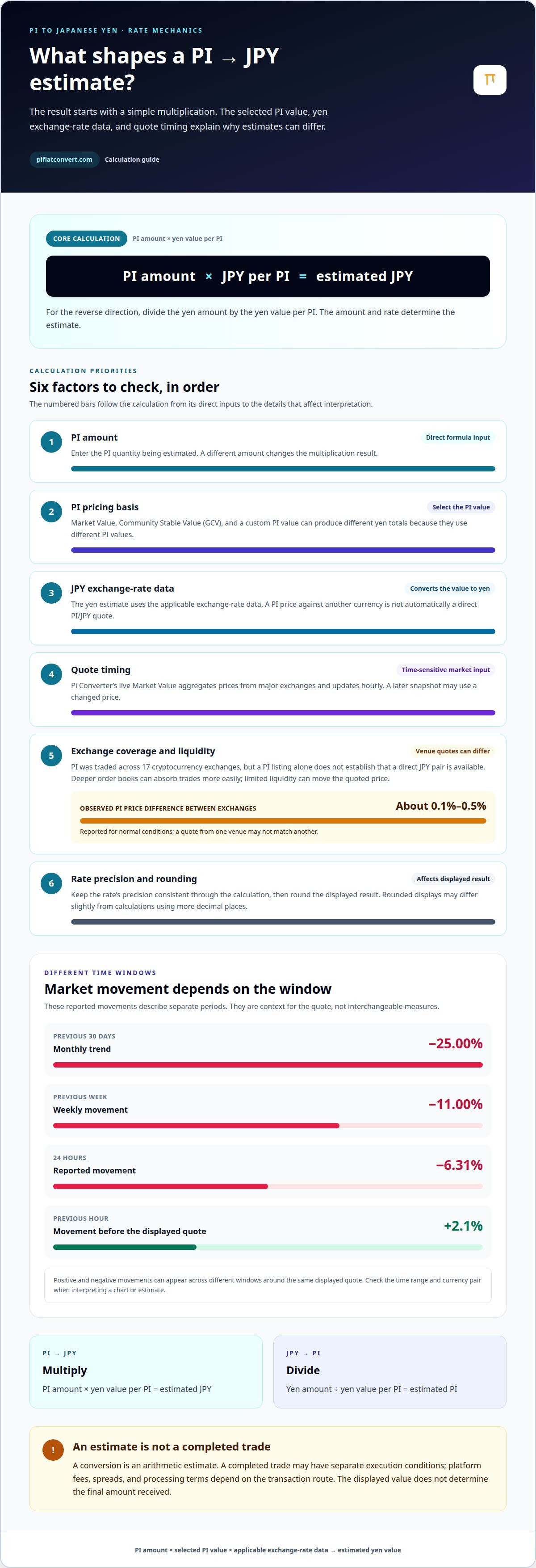
How the PI/JPY rate is calculated
A PI/JPY rate is the yen value assigned to one PI for a selected pricing basis. To calculate a conversion, multiply the PI amount by that rate. The rate and amount determine the estimate.
A market rate reflects prices drawn from trading activity, while a custom value uses a PI price you enter. Pi Converter’s live Market Value aggregates prices from major exchanges and updates hourly. Conversions use current exchange rates, so the yen estimate depends on the selected PI value and the exchange-rate data used in the calculation.
Community Stable Value, or GCV, is an alternative pricing basis to Market Value. The two can produce different results because they use different PI values. A custom PI value offers another input: the calculation multiplies it by the PI amount, then expresses the result in JPY using the applicable exchange rate.
To convert PI to yen, use this relationship: PI amount × yen value per PI = estimated JPY. To reverse the calculation, divide the yen amount by the yen value per PI. Keep the rate’s precision consistent throughout the calculation, and round only the displayed result. Rounding earlier can cause small differences in the final figure.
The live rate is a time-sensitive quote, not a permanent valuation for PI. An hourly update may reflect a changed Market Value, while the JPY conversion also depends on the current exchange rates applied. Before interpreting a result, identify whether it uses Market Value, GCV, or a custom value. This helps explain why the same PI amount can produce different yen totals.
For a rate-based estimate, calculate a PI-to-JPY conversion using the PI amount and pricing basis relevant to your comparison. The displayed result helps translate the selected value into yen; it doesn’t represent an exchange or brokerage transaction.
Pi Converter
Pi Converter helps you estimate PI’s value in Japanese yen using your selected pricing basis: Market Value, community Stable Value (GCV), or a custom PI value. Compare how each input affects the conversion estimate.
Use it when you need to translate a PI amount into JPY or compare estimates based on different PI values. It also converts PI into USD, EUR, GBP, NGN, KES, and other fiat currencies, which can help place a yen estimate in broader currency context. The tool calculates values; it doesn’t provide Pi Coin exchange or brokerage, a wallet, or mining.
If you have questions about using Pi Converter for a PI-to-JPY estimate, contact Pi Converter.
Make your next PI-to-yen decision with clarity
A conversion estimate is most useful when it supports a specific task, such as reviewing a balance or comparing possible outcomes. Before acting on a PI valuation, decide what the yen figure represents and use that purpose consistently. This makes the Pi to JPY Japanese Yen rate easier to interpret as a reference point, not a decision on its own.
Market values can change, so an estimate should be understood in relation to its pricing basis and timing. If you need help using the conversion tool or understanding its displayed result, contact Pi Converter for help. A clear question about the amount or pricing basis you’re considering can make the next step more focused.
Use the calculation as a practical starting point, then consider that context when making your own decision. A measured approach keeps the numbers useful without asking them to answer more than they can.
Frequently Asked Questions
This is a rate-based equivalent, not confirmation that a purchase can be completed for that amount. Trading availability and execution terms are separate from this calculation.
How much is 1 Pi Network worth in JPY?
Treat the figure as a dated quote, not a lasting valuation: the yen equivalent depends on the PI price used for the estimate. To review a balance, multiply its PI amount by the applicable yen-per-PI quote, keeping the quote’s timestamp in view.
What is the highest price of PI/JPY in history?
An all-time high is the highest historical quote in the recorded price series. It does not indicate the current value or establish what a future conversion would return. For context, compare a historical peak with a dated current quote and the time period shown, rather than treating the peak as a price target.
What is the price trend of Pi Network in JPY?
The recorded trend was downward across the previous 30 days, with the PI-to-JPY rate falling 25.00%; it had also declined 11.00% over the previous week. These periods overlap, so they describe related movements rather than separate changes to add together. A trend summary can provide context, but the specific quote still depends on the market snapshot used for a conversion.
What is the current Pi Network (PI) to Japanese yen (JPY) exchange rate?
The quote expresses PI’s value in JPY at that snapshot, while a later market update may show a different figure. For a conversion estimate, use the rate that matches the amount and timing you’re assessing. Keep the currency pair consistent: a PI quote against another currency is not itself a PI-to-JPY quote.
How much is 1 PI in Japanese yen today?
“Today” refers to the dated quote here, not a price that remains unchanged throughout the day. When reviewing a PI balance, use a quote aligned with the time of your estimate. Small differences in timing or pricing basis can change the displayed yen equivalent.