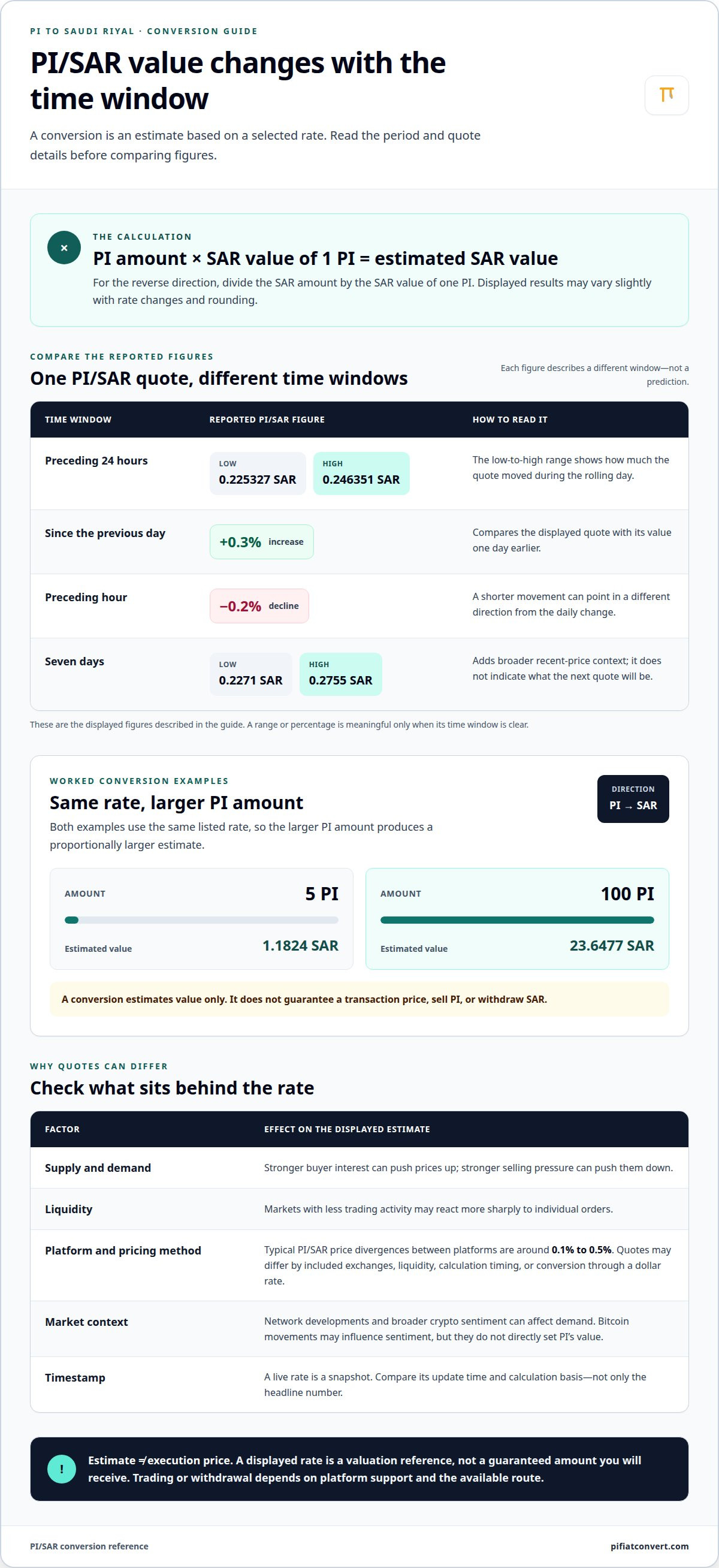
PI’s value in Saudi riyals depends on the rate used, so the same amount can produce different totals as market prices change. A Pi to SAR Saudi Riyal calculation multiplies the PI amount by the SAR value of one PI; at one listed rate, 5 PI equals 1.1824 SAR and 100 PI equals 23.6477 SAR.
Before comparing values or making a decision, it helps to know what a conversion figure represents. A Pi to SAR Saudi Riyal calculation estimates value; it does not guarantee the amount you could receive in a transaction. This guide explains how to calculate the estimate, interpret PI-to-SAR rates, and understand why Pi’s value can change. It also shows how to compare a market-based estimate with other valuation methods.
Key Takeaways
- Calculate an estimated SAR value by multiplying the PI amount by the current PI-to-SAR rate.
- Compare conversion examples with the displayed rate, since Pi’s market value can move over time.
- Understand why rate sources, market activity and timing can affect the amount shown.
- Use a converter to compare a current market-based estimate with other Pi valuation methods.
PI-to-SAR conversion examples
A Pi to SAR Saudi Riyal calculation converts a Pi Network amount into Saudi riyals using a quoted rate. Multiply the amount of PI by the SAR value of one PI. At the listed rate, 5 PI equals 1.1824 SAR, while 100 PI equals 23.6477 SAR. Both examples use the same rate, so the larger amount produces a proportionally larger estimate. A table’s highest amount does not necessarily indicate a better rate.
A SAR-to-PI conversion starts with riyals and estimates the corresponding PI amount. For the reverse comparison in a Pi to SAR Saudi Riyal calculation, divide the SAR amount by the SAR value of one PI. Displayed results may differ slightly because rates and rounding vary.
A fiat conversion expresses PI in a government-issued currency, such as USD, EUR, GBP, NGN, KES, or SAR. Because each currency has its own exchange rate, the same PI amount can produce different fiat values. Pi Network price figures can change, so note the rate and its update time when comparing currencies. A conversion estimates value but does not transfer funds.
A crypto conversion estimates the value of one digital asset in another, rather than in fiat. For example, a PI-to-crypto quote depends on the selected PI price and the other asset’s rate. Trading exchanges the assets, so the transaction outcome may differ from the calculation. Platform or network fees may also affect the proceeds.
Can PI be sold or withdrawn for Saudi riyals in Saudi Arabia? A Pi to SAR Saudi Riyal calculation estimates value only; it does not sell PI or withdraw SAR. A sale or withdrawal depends on whether a platform supports the transaction and the relevant withdrawal route.
What Influences the PI to SAR Exchange Rate?
A live PI-to-SAR exchange rate estimates the value of one PI in Saudi riyals at a particular time. It can change as trading activity and prices shift across crypto markets. Treat the displayed figure as a snapshot, not a permanent value, and note its update time before comparing it with another quote.
The PI-to-SAR rate generally reflects market prices, not an official Pi exchange rate set by a central authority. The Saudi riyal provides the fiat comparison, while PI’s price reflects market trading. A quote may also use an intermediate currency, such as the US dollar, converting PI to dollars first and then to SAR.
Supply and demand are key influences on Pi Network’s market price. Prices can rise when buyers seek PI more actively than sellers offer it, and fall under stronger selling pressure. Liquidity matters too: markets with less trading activity may react more sharply to individual orders. Network developments and broader crypto sentiment can affect demand. Bitcoin price movements may influence sentiment across digital assets, but they do not directly set PI’s value.
A platform difference is a gap between PI/SAR quotes shown by separate services. In normal conditions, typical PI/SAR price divergences between platforms are around 0.1% to 0.5%. Differences can reflect the exchanges included, available liquidity, calculation timing, and whether the quote converts through a dollar rate. Compare the rate timestamp and calculation basis, not just the headline number.
For a useful live comparison, read the PI/SAR exchange rate alongside its update time and pricing method. Check whether the figure reflects a market price or another valuation basis. With a market quote, changes in trading activity, liquidity, supply, or demand can alter the estimate even when the PI amount stays the same. A displayed rate is a valuation reference, not a guaranteed execution price.
How does a professional convert the price of PI to SAR?
A PI-to-SAR conversion applies a Saudi riyal rate to a specified PI amount. To calculate the reference value, multiply the PI amount by the selected rate and note the rate’s timestamp. The result estimates value; it is not a completed sale or withdrawal.
The 24-hour price range is the interval between PI’s lowest and highest SAR quotes during a rolling day. In the displayed figures for November 16, 2026, PI/SAR fluctuated between 0.225327 SAR and 0.246351 SAR during the preceding 24 hours. That spread shows why a conversion made at one time may differ from a later calculation, even when the PI amount remains unchanged.
A 24-hour price change measures how the latest PI/SAR quote compares with its value the previous day. The displayed price had increased 0.3% since the previous day, while the price had declined 0.2% over the preceding hour. These short-term movements describe different time windows; one does not cancel out the other. A professional states the interval used, rather than presenting a percentage without context.
Recent price changes are movements across defined periods, such as a week or a month. In the seven-day figures, PI’s highest price was 0.2755 SAR and its lowest was 0.2271 SAR. This range gives context to the latest conversion rate, but it doesn’t predict the next price. Market activity and liquidity help explain why the market price can move between observations.
To prepare a clear valuation, a professional identifies the PI amount, selects a PI/SAR rate, applies the multiplication, and reports the rate’s timestamp and period. For example, a valuation based on the 24-hour range should show whether it uses the low, high, or latest quote. That distinction lets readers understand what the figure reflects and compare it with another reference without confusing a price estimate with a trade execution.
Current SAR-to-PI and PI-to-SAR exchange rates
An exchange rate shows how much of one currency corresponds to another at a given quote. These are inverse views of the same conversion relationship, rounded for display. For a Pi to SAR Saudi Riyal calculation, start with PI; use the reverse direction when starting with riyals.
A conversion table applies a quoted rate to different amounts, making estimates easier to compare. At the listed rate, 5 PI equals 1.1824 SAR, and 100 PI equals 23.6477 SAR. Small differences between reverse calculations can result from rounding, so interpret each displayed value as an estimate.
A 24-hour change compares the latest exchange rate with its earlier value over the preceding day. The listed SAR-to-PI rate was down 1.00% over the previous 24 hours and up 9.00% over the previous week. These periods describe separate movements, not a forecast. Trading volume and liquidity can affect how closely a displayed quote reflects a price available for a transaction.
For a practical reference, read the PI amount, SAR result, rate direction, and update time together. A Pi to SAR Saudi Riyal calculation can help estimate value, but a quote alone does not execute a trade. Figures are informational estimates, and actual transaction proceeds may differ. If you save or download a rate table, include its timestamp so later comparisons retain context.
To compare a PI amount with its current SAR estimate, convert PI to Saudi riyals using the displayed rate, then interpret the result as a reference rather than a guaranteed transaction value.
Pi Converter
Pi Converter helps you estimate Pi’s value in Saudi riyals using a selected valuation basis. Enter a PI amount to compare its estimated fiat value, without treating the calculation as a completed trade or withdrawal.
The tool offers Market Value, based on live market data aggregated from major exchanges and updated hourly, alongside the community Stable Value (GCV) and a custom Pi value. These options make it easier to see how a chosen rate changes the SAR estimate. Pi Converter also supports USD, EUR, GBP, NGN, KES, and 100+ other currencies, so you can use the same reference for comparisons beyond SAR.
Use Pi Converter when you need a current market-based estimate or want to compare valuation assumptions. For help using the conversion reference, contact Pi Converter.
Make your next PI valuation decision with context
A Pi to SAR Saudi Riyal calculation is most useful when it supports a specific decision, such as tracking a holding or assessing a possible conversion. Before acting on the displayed value, decide whether you need a quick reference or a figure for a transaction. This distinction helps prevent mistaking an estimate for an executable offer.
For ongoing comparisons, keep the valuation basis consistent and note when you checked it. If your purpose changes, reassess which rate approach is relevant instead of carrying an old estimate forward. This gives you a clearer record of how you reached your view as market conditions shift.
If you want help using Pi Converter for a Pi-to-SAR reference, contact Pi Converter for help. Take the next step with a clear purpose and a value you can interpret.
Frequently Asked Questions
How many PI can I buy for SR1?
At the listed reference rate, SR1 corresponds to 4.2287 PI. This is a conversion estimate, not a purchase quote. If you’re comparing a transaction, distinguish the calculated token amount from the amount an exchange would execute; the rate used, its timing, and transaction conditions can affect the final result. Keep the displayed precision consistent when comparing quotes.
How much is 1 Pi Network worth in SAR?
Using the listed PI-to-SAR reference, 1 Pi Network (PI) is worth approximately SAR 0.236477. A displayed price is a snapshot rather than a fixed valuation, so the estimate may differ from another quote taken at a different time or using another pricing basis.
What is the highest price of PI/SAR in history?
An all-time high is the highest PI/SAR price recorded across the historical period and market data being considered. A recent daily or weekly high cannot establish it, because those cover shorter intervals. For a useful comparison, identify the historical timeframe and price series first. Figures from different venues or quote methods may not match exactly.
What is the current PI to SAR exchange rate?
The PI-to-SAR reference rate can vary, so treat any displayed conversion as an estimate rather than a guaranteed quote. Treat this as a rate snapshot, not a lasting quote: PI prices move with market conditions, and a current display can change after it updates. For a specific calculation, use the rate shown at that moment and note whether it represents market value or another valuation basis.
How does a professional calculate the value of PI in SAR?
To estimate the SAR value, multiply the PI amount by the chosen PI/SAR rate. State whether the calculation uses a market quote or another pricing basis, and record the rate’s timestamp and displayed precision. This makes the estimate easier to interpret and compare without presenting it as completed proceeds.
How much is 1 PI worth in Saudi riyals?
A listed PI-to-SAR rate is an estimate, and the value can vary with the pricing basis and timing. The number of decimal places matters when reading a small conversion, because rounding can change the displayed total for larger PI amounts. Use the same rate and precision throughout a comparison, and treat the result as an indicative valuation rather than a guaranteed sale amount.