Converting Pi to local currency means applying a current PI-to-fiat rate. The amount you might receive in a trade can also depend on the available trading pair, liquidity, and withdrawal options.
A converter’s figure may look like the amount you can cash out, but a conversion estimate and an executable trade are different. This guide explains how to calculate Pi’s fiat value, what can affect its USD rate, and how trading Pi for stablecoins or fiat works in practice. It also covers recent price movements and what to consider when comparing a quoted rate with a possible withdrawal amount.
Key Takeaways
- Compare the community Stable Value, live Market Value, and a custom Pi value to see how different pricing bases affect a fiat estimate.
- Use the calculator to convert Pi into USD, EUR, GBP, NGN, KES, and other supported currencies with current exchange rates.
- Before planning a trade or cash-out, understand how platform support, available trading pairs, liquidity, and withdrawal conditions shape the process.
- Keep a record of conversion dates, amounts, rates, and proceeds, and review the tax rules that apply in your jurisdiction.
Converting PI to other fiat currencies
To convert PI into fiat, apply a selected Pi price to your chosen currency. Enter the PI amount, choose a rate basis, then convert the result into the currency you need.
Locale-Dependent Currency Conventions
Regional formatting conventions determine how currencies and numbers are displayed. They affect how a conversion looks, not the underlying exchange rate.
The same amount can look different depending on the currency symbol, its placement, the decimal separator, and digit grouping. For example, a USD value may use a decimal point in one format and a decimal comma in another. Check the currency code as well as the symbol: “$” can represent more than one currency.
For a useful local estimate, select your target fiat currency, then read its code and amount together. A PI conversion to USD, EUR, GBP, NGN, or KES is clearer than relying on a symbol alone. Formatting can affect how you read a figure, but not its calculated value.
Live Pi-to-USD Conversion Rate
A live Pi-to-USD rate is the current quoted value of one PI against one US dollar. On November 1, 2026, one PI was listed at 0.077856 USD.
That rate is a time-specific snapshot, not a fixed value. The listed price can move as market conditions and exchange activity change. A live market-value estimate can aggregate prices from major exchanges and update hourly, while a conversion may also use a community Stable Value or a custom PI value. These methods can produce different estimates because they use different price bases.
To estimate the value, multiply the PI amount by the selected USD rate. Then convert the USD result into your target currency using its current exchange rate. A PI-to-local-currency estimate therefore depends on both the selected PI valuation and the fiat conversion rate. Check the update time for each rate before comparing amounts.
Pi-to-USD Conversion Examples
Pi-to-USD conversion examples show how the listed per-PI rate scales with the amount converted. At 0.077856 USD per PI, the listed values were 0.389279 USD for 5 PI and 0.778558 USD for 10 PI.
These examples help you estimate the gross conversion before considering the terms of a separate trade. Displayed figures are rounded, so multiplying a quoted rate may produce a slightly different final digit.
For a practical conversion, use this sequence:
- Enter the PI amount, such as 10 PI.
- Select the valuation basis, such as live Market Value or a custom PI value.
- Choose USD or another supported fiat currency, including EUR, GBP, NGN, or KES.
- Read the converted amount and note the rate’s update time.
A converter simplifies the calculation, but the valuation you select matters. A Stable Value estimate answers a different question from a market-based quote. To compare two results, keep the PI amount and target currency the same, then check the valuation basis and timestamp. This helps explain why the figures differ.
Treat the displayed local-currency amount as a reference, not a guarantee that a market or transaction will use the same quote. The final figure depends on the rate applied at conversion and the currency selected. Keep the currency code, PI amount, and rate basis together so you can interpret the calculation later.
Trading Pi for stablecoins or fiat
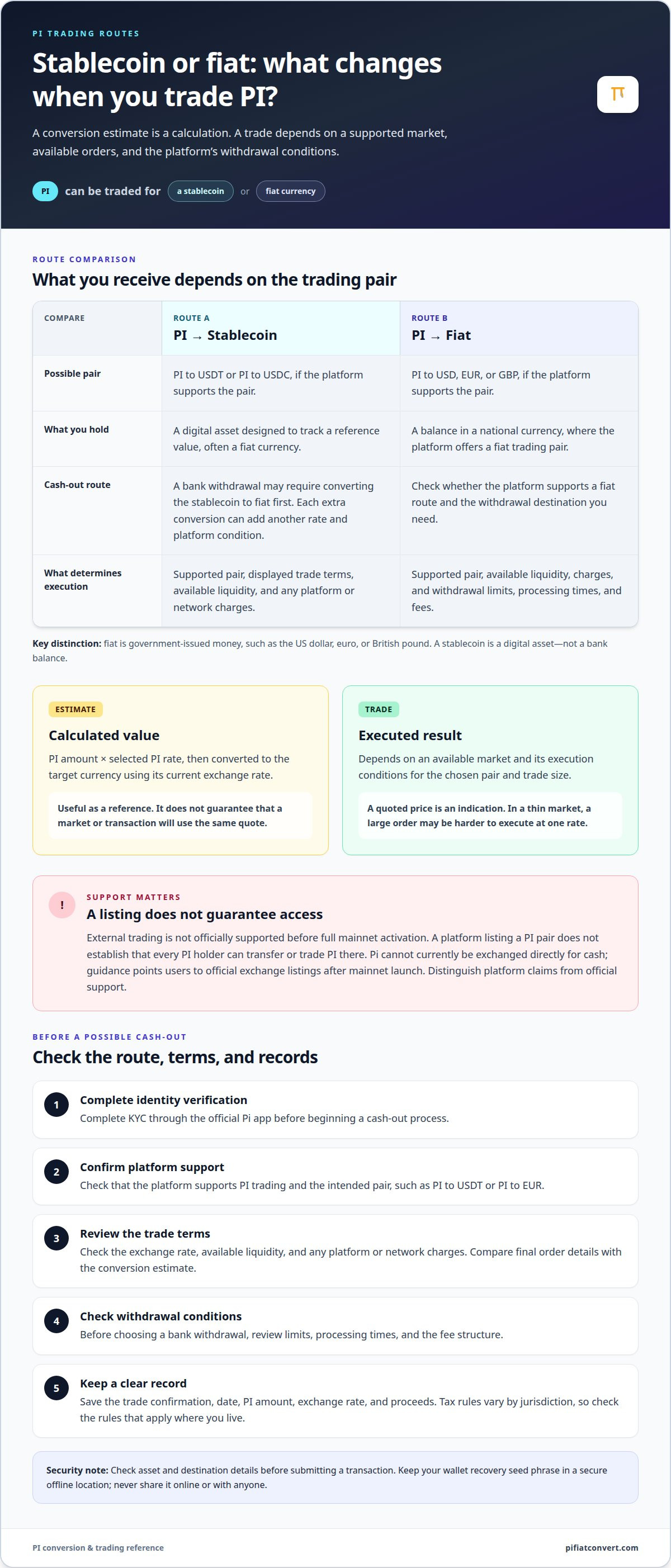
A Pi trade exchanges PI for another asset through a supported trading platform. The result may be a stablecoin, such as USDT or USDC, or fiat currency, such as USD, EUR, or GBP, if the platform supports that pair. A conversion estimate is a calculated value; a trade depends on an available market and its execution conditions.
A stablecoin is a digital asset designed to track a reference value, often a fiat currency. Fiat is government-issued money, including the US dollar, euro, and British pound. The routes differ: a PI-to-stablecoin trade leaves you holding a digital asset, while a fiat trading pair may show a balance in a national currency.
Platform support determines which route is available. External trading is not officially supported before full mainnet activation, and a platform listing a pair does not establish that every PI holder can transfer or trade PI there. Pi cannot currently be exchanged directly for cash; guidance points users to official exchange listings after mainnet launch. Separate markets may advertise PI pairs, so distinguish platform claims from official support.
Before starting, make sure the route suits your goal. For a digital dollar equivalent, look for a supported PI-to-USDT or PI-to-USDC pair. For a bank withdrawal, find out whether the platform offers a PI-to-fiat route or requires an intermediate stablecoin trade. Each extra conversion can introduce another rate and platform condition.
Use this sequence to assess a possible cash-out:
- Complete KYC verification through the official Pi app before beginning a cash-out process.
- Identify whether the chosen platform supports PI trading and the desired pair, such as PI to USDT or PI to EUR.
- Review the displayed trade terms, including the exchange rate, available liquidity, and any platform or network charges.
- Check the platform’s withdrawal limits, processing times, and fee structure before choosing a bank withdrawal.
- Keep the trade confirmation and record its date, amount, exchange rate, and proceeds.
Liquidity affects how closely a trade may match its displayed quote. A quoted price is an indication; execution depends on the available orders for the chosen pair and trade size. In a thin market, a large order may be harder to execute at one rate. Compare the final order details with the conversion estimate, and distinguish an estimated value from a completed trade.
KYC means identity verification. Pi users should complete it through the official Pi app before beginning cash-out. This step does not guarantee that a platform supports a particular PI pair or withdrawal route. Check the asset and destination details before submitting a transaction. Keep your wallet recovery seed phrase in a secure offline location, and never share it online or with anyone.
Keep records after a conversion as well as during it. Save the transaction date, PI amount, exchange rate, and proceeds for each trade. Tax rules vary by jurisdiction, so check the rules that apply where you live. Clear records help connect the original PI amount with any later stablecoin conversion or fiat withdrawal.
If you’re comparing an estimate with a possible trade, use a Pi-to-fiat conversion estimate as a reference, then assess the platform’s pair and withdrawal conditions separately. This keeps the calculation distinct from the practical steps needed to move proceeds into a bank account.
Record cryptocurrency conversion dates, amounts, exchange rates, and proceeds, and check the tax rules in your jurisdiction. Before withdrawing funds to a bank account, review the exchange’s withdrawal limits, processing times, and fees.
Pi Converter: Pi Converter
Pi Converter helps you estimate Pi’s value in fiat currencies. Use it to compare a conversion estimate before considering separate trading or withdrawal steps.
Choose a pricing basis, enter the PI amount, and select a destination currency. The tool supports USD, EUR, GBP, NGN, KES, and more than 100 other currencies. You can compare the community Stable Value, live Market Value, or a custom Pi value, then review the converted estimate using current exchange rates. Its live Market Value is aggregated from major exchanges and updated hourly.
The result is a conversion estimate, not a Pi Coin exchange or brokerage transaction, wallet, or mining service. For a straightforward way to calculate a fiat equivalent, visit Pi Converter.
Make Your Next Pi Decision Deliberate
Before converting Pi to local currency, decide what you need the estimate for. A figure used for personal planning may serve a different purpose from one used to assess a potential transaction. Keeping your purpose clear helps you choose a consistent reference and avoid treating a calculation as a commitment.
Consider how you’ll use the result, the assumptions behind it, and whether they still fit your decision. This makes future comparisons more meaningful, especially as market conditions and your plans change. The aim isn’t to predict every outcome, but to take the next step with a clearer understanding of what the figure represents.
For a practical conversion tool, contact Pi Converter for help. Use the estimate as a starting point for your own decision, and move forward with care.
Frequently Asked Questions
What Influences the PI to USD Exchange Rate?
The PI-to-USD exchange rate mainly reflects buying and selling activity, available liquidity, and trading on supported markets. Stronger demand can raise quoted prices, while heavier selling can lower them. Exchange-specific order activity may also cause quotes to differ. Trading volume can indicate market activity, but it does not predict future prices.
What is the current Pi Network coin price in USD?
At 09:44:49 on November 1, 2026, 1 PI was listed at 0.077856 USD. Treat this as a timestamped quote, not a guaranteed cash-out amount, since market activity can change the rate. For a useful comparison, record the quote’s time and whether it uses a market value, community Stable Value, or custom valuation.
What is the Pi coin price in other local currencies?
Pi’s value in another currency depends on the selected PI valuation and the current exchange rate between USD and that currency. A quote in euros, naira, or Kenyan shillings can change as fiat exchange rates move, even if the PI-to-USD quote stays the same. Select the exact currency code, since symbols such as “$” can represent different currencies.
How can I convert Pi to USD or another local currency?
Enter the PI amount, choose a valuation basis, and select the fiat currency you want. For example, someone estimating a 25 PI holding in euros should use the same valuation basis for each comparison and check the resulting currency code. A calculator gives an estimate for the chosen inputs; it doesn’t itself complete a trade or bank withdrawal.
How can I check the current Pi exchange rate reliably?
Use a quote that identifies the PI trading pair, valuation basis, and update time. Compare like with like: a market-based PI/USD quote and a community Stable Value answer different questions. If two rates differ, check their timestamps and methods before relying on either. For a transaction, distinguish the latest estimate from the rate shown when the order executes.