A PI-to-KES quote can change with the Pi valuation used and the market rate at the time of conversion. Pi Network traded between 9.72 and 10.07 KES during the 24 hours shown. A Pi to KES calculator may therefore give different estimates depending on whether it uses market value, the community Stable Value (GCV), or a custom Pi value.
That variation matters when you’re estimating a conversion into Kenyan shillings: the displayed amount depends on both the Pi price basis and the currency exchange rate. This reference explains what influences the PI-to-KES rate, provides context for converting in either direction, and outlines supported fiat currencies. These include KES, USD, EUR, GBP and NGN, as well as more than 100 other currencies, so you can see how the Kenyan shilling fits into a broader set of conversion options.
Key Takeaways
- Read PI-to-KES and KES-to-PI tables in the correct direction to estimate the amount before converting.
- Separate a quoted market rate from the Pi valuation method behind it; the choice can change the estimate.
- Account for market movements and changing liquidity when interpreting a displayed exchange rate.
- Use Pi Converter to compare fiat conversions with market value, Stable Value (GCV), or a custom Pi value.
PI-to-KES and KES-to-PI conversion tables
A Pi to KES calculator shows the Kenyan shilling (KES) value of Pi Network (PI), or the equivalent amount of PI for a KES value. Check the conversion direction and the rate basis before using the estimate.
For example, one displayed conversion lists 1 PI as KES 0.70, while another quote places PI between 9.72 and 10.07 KES during the 24 hours shown. These figures differ, so treat each table as a snapshot of its chosen price source and valuation method, not as interchangeable quotes. The inverse table may show KES converted into a fraction of PI.
To track rates, compare quotes with the same direction and valuation basis. Note the update time, then check whether the PI quote and KES estimate move together. Market activity can change the quote, and the calculated amount changes with it.
Pi Amount Conversion Examples
Pi amount conversion examples apply a quoted PI-to-KES rate to a chosen quantity of Pi. The conversion examples apply a displayed PI-to-KES rate to selected amounts to show estimated values.
Apply the same calculation to other amounts, or use a Pi to KES calculator to see estimates at different amounts without changing the rate. If you’re reviewing a wallet balance or considering a trade, remember that a calculated value is not an executed transaction.
Conversion Rate Calculation
A conversion rate states how much of one currency equals one unit of another. To convert PI to KES, multiply the PI amount by the KES-per-PI rate. To convert KES to PI, divide the KES amount by that rate.
For PI-to-Bitcoin (BTC) conversion, use the PI/BTC quote or calculate from a BTC-to-PI table. One listed table shows 1 BTC as 1005895.55384106 PI at the time shown. Dividing the PI amount by that table value gives its BTC equivalent. A direct PI-to-BTC quote may differ as market prices update.
What Influences the PI to KES Exchange Rate?
The PI-to-KES exchange rate shows Pi’s market value in Kenyan shillings. Comparing it across time periods can help distinguish short-term changes from broader price trends.
Indicative Rates and Price Fluctuations
An indicative rate is an estimate of the value used to calculate a PI-to-KES conversion. The rate fell by 1.93% over the last 24 hours as of November 3, 2026, and changed by -0.02% over the seven days shown. Over one month, the exchange rate fell by 13.53%, illustrating how the time period changes the picture.
Cryptocurrency prices respond to trading activity and liquidity. The KES value also depends on its exchange rate against the market price used. If the calculation first converts PI to USD, movements in the dollar market can affect the final KES quote.
Live and Current Rates
A live cryptocurrency rate is a quote that updates as its underlying market data changes. The current PI-to-KES rate applies to a particular source and update time; it is not a fixed price for the whole day.
Compare the displayed rate with its timestamp and period change. A 24-hour movement describes a different interval from a seven-day or monthly change, so neither alone explains every fluctuation. For informational purposes only, an indicative conversion estimates value; it doesn’t establish the amount available in a completed exchange.
Price Differences, Risks, and Data Updates
Prices can differ across platforms because trading activity and liquidity vary. A Pi to KES calculator should identify the rate and valuation basis it uses, so you can interpret the estimate accurately.
Volatility, low liquidity, stale data, and changes in the KES exchange rate can affect an estimate. The displayed amount may also exclude fees or gas costs, so it is not a guaranteed transaction amount.
Update the quote whenever its underlying price or currency-rate feed refreshes, and show the time of the latest update. Since cryptocurrency trading operates 24/7, a quote can become outdated between refreshes. To compare Pi and fiat values, use Pi-to-fiat conversion estimates with the selected valuation basis in view.
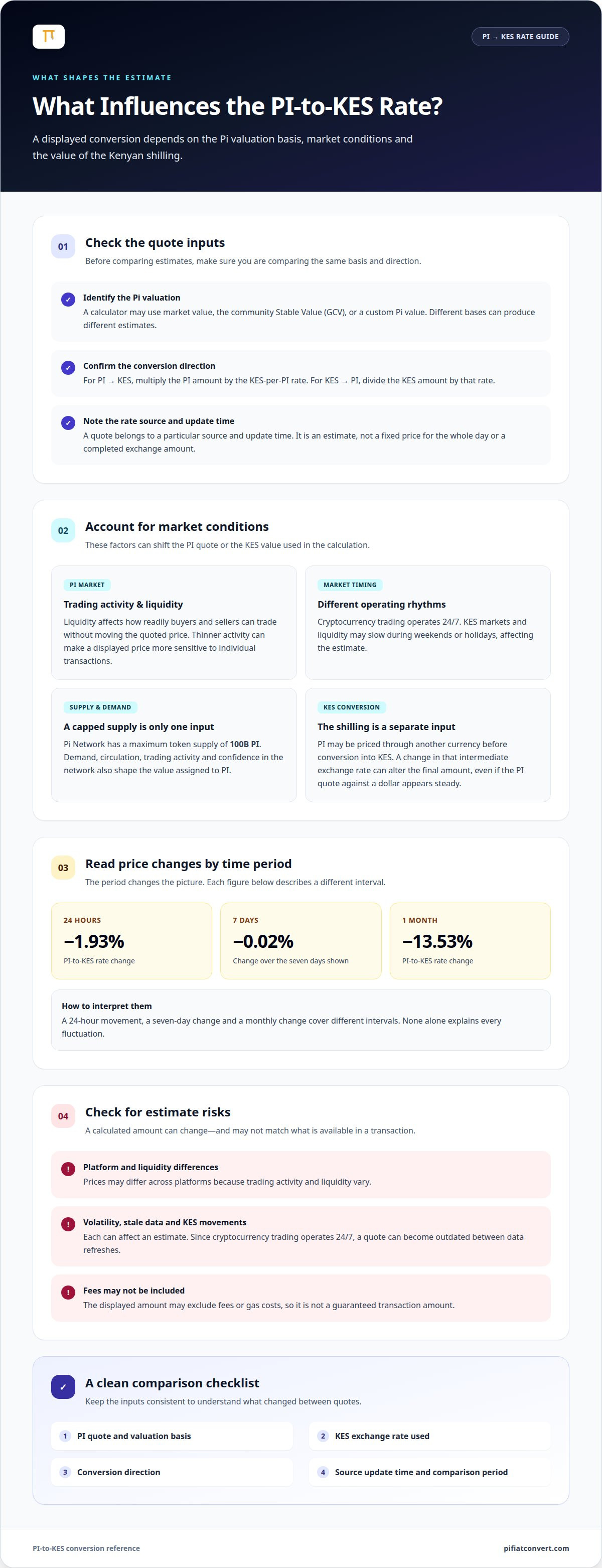
Factors influencing the PI-to-KES rate
An exchange rate shows how much Kenyan shilling one unit of Pi Network (PI) represents. The PI-to-KES quote combines PI’s assigned market value with the value of KES against the relevant pricing currency. Before converting, identify the Pi valuation basis and the shilling exchange rate used.
Liquidity describes how readily buyers and sellers can trade an asset without moving its quoted price. Cryptocurrency trading operates 24/7, while KES markets and liquidity may slow during weekends or holidays. When trading activity thins, fewer available orders can make a displayed PI price more sensitive to individual transactions. That can affect the estimate even if the amount of PI stays unchanged.
Supply and demand describe the balance between available PI and buyers seeking the asset. Pi Network has a maximum token supply of 100B PI. That cap is one element of market data, not a price forecast: demand, circulation, trading activity, and confidence in the network also shape the value assigned to PI. Investment interest can shift as participants reassess those factors.
The KES side also matters because PI is often priced through another currency before conversion into the shilling. A change in the intermediate exchange rate can alter the final KES amount, even when the PI quote against a dollar appears steady. The Kenyan shilling’s role as the local currency makes its market value a separate input, rather than a fixed conversion constant.
For a useful comparison, record the PI quote, valuation basis, KES exchange rate, and update time. Compare those inputs with a later quote using the same basis. This helps show whether the change came from Pi Network or the shilling. A wallet balance alone does not determine market value; the selected rate and market conditions do.
The 24-hour high and low were KES 35.96 and KES 35.81 per PIP. The 90-day PI-to-KES change was -14.16%.
Supported fiat currencies
A supported fiat currency is a government-issued currency available as a conversion output. Options include the Kenyan shilling (KES), US dollar (USD), euro (EUR), pound sterling (GBP), and Nigerian naira (NGN), alongside more than 100 other currencies. This range lets readers compare Pi values across different monetary reference points, not just the Kenyan market.
Choose KES to estimate a local-currency value, or select USD, EUR, GBP, or NGN for another fiat equivalent. Changing the currency changes the output unit, not the PI amount entered. To compare currencies clearly, keep the Pi valuation basis consistent and change only the fiat currency.
Which exchanges let users in Kenya buy or sell Pi for KES? If you are considering a platform, check whether it lists the PI/KES pair and is available to users in Kenya. Fiat conversion support alone does not mean the platform enables buying or selling, and a conversion reference is not an exchange.
Bitcoin (BTC) is a cryptocurrency, not fiat currency, so compare it separately from KES or USD. A BTC quote and a Kenyan shilling quote represent different markets and units. For clarity, note the selected asset, currency, Pi valuation basis, and timestamp when comparing displayed amounts.
For example, compare the same Pi amount in KES and USD, then switch to EUR or GBP while retaining the same Pi valuation basis. This separates changes in the selected currency from changes in Pi’s quoted value. Use Pi fiat currency conversions to view supported fiat outputs and compare estimates. A conversion estimate doesn’t execute trading actions or establish a transaction price.
Currency World lists 1 PiCoin as 4.384982 Kenyan shillings. The Kenyan shilling was introduced in 1966 to replace the East African shilling as Kenya's official currency.
One month before the stated update, one Pi Network (PI) was valued at 11.37 Kenyan shillings (KES), and its value had fallen by 13.47% to the current rate.
Pi Converter
Pi Converter helps you estimate Pi Coin values in Kenyan shillings and other fiat currencies. Use the free tool to compare a KES conversion under a specific Pi valuation basis instead of relying on an unexplained quote.
Select the community Stable Value (GCV), live Market Value, or a custom Pi value to calculate an estimate. Market Value is aggregated from major exchanges and updated hourly, while conversions use current exchange rates. The tool also supports USD, EUR, GBP, NGN, KES, and more than 100 other currencies.
These calculations provide conversion references; Pi Converter isn’t a Pi Coin exchange or brokerage, wallet or custody service, or mining service. If you’d like help using Pi Converter for a fiat conversion, contact Pi Converter.
Make Your Next Conversion Decision with a Clear Reference
Use a Pi to KES calculator as one input in a practical decision, not as a substitute for deciding what the estimate is for. A personal budget, portfolio record, and planned exchange each need different context. Note your intended use and the amount you’re evaluating before relying on a displayed figure.
For future comparisons, keep the purpose and currency consistent, and update your assumptions when your plans change. This makes estimates easier to interpret without treating a short-lived quote as a long-term expectation. Keep investment decisions separate from the arithmetic: a calculated equivalent does not determine whether an asset suits your circumstances.
If you need help using Pi Converter for a fiat conversion, contact Pi Converter for help. Take the next step with a clear purpose and a reference that fits your decision.
Frequently Asked Questions
What is the current Pi Network coin price in Kenyan shillings (KES)?
The displayed 24-hour average was 9.93 KES per PI on November 3, 2026. This is a time-specific reference, not a fixed price: the quote can change as market data updates. For a practical estimate, use the rate and valuation basis shown when you calculate, and distinguish an indicative conversion from the amount of a completed trade.
How do I convert Pi to KES using a calculator?
Enter the Pi amount, select KES as the output currency, and choose a valuation basis: community Stable Value (GCV), live Market Value, or a custom Pi value. The calculator applies the corresponding rate and displays an estimate in Kenyan shillings. Check the selected basis before comparing results.