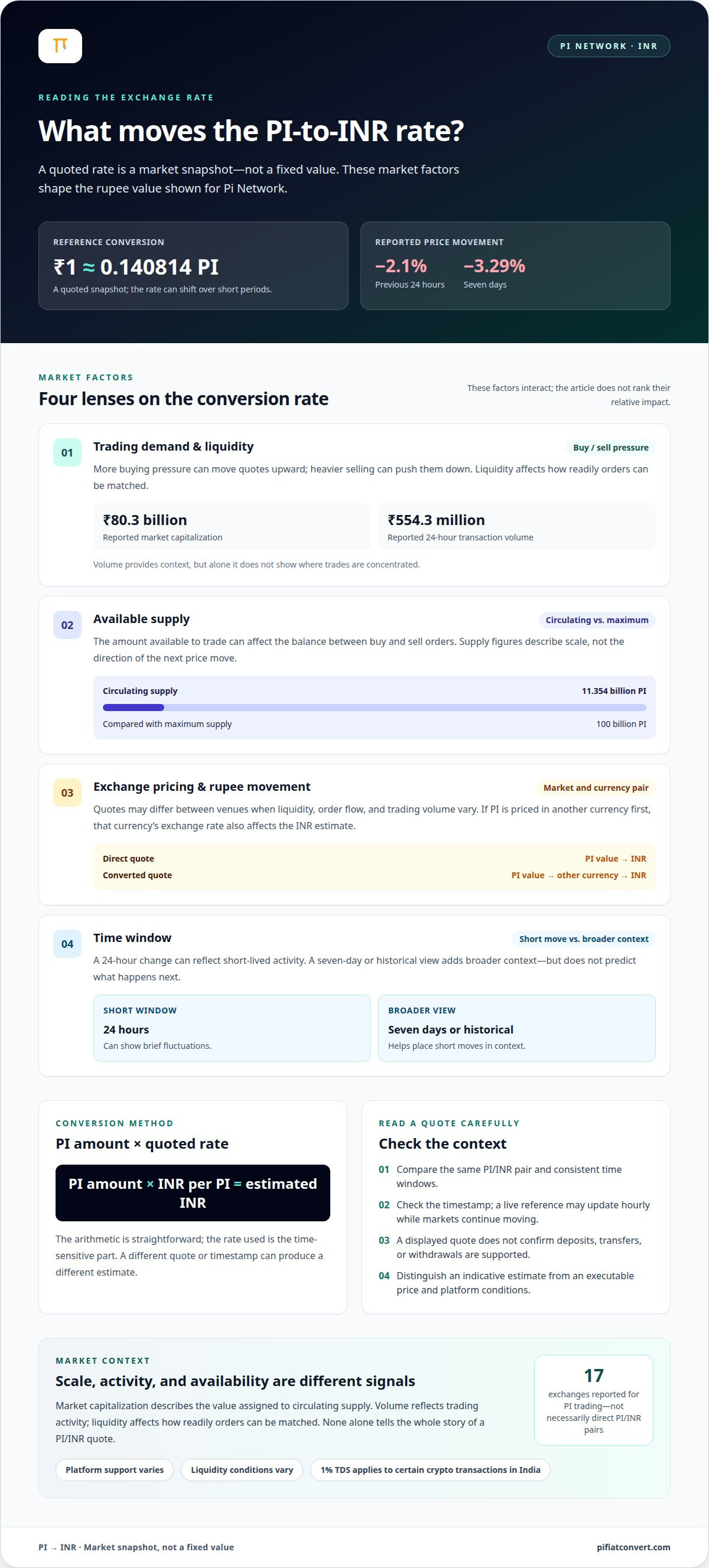
Pi’s quoted value against the Indian rupee can shift over short periods, so an exchange rate is best treated as a snapshot. At that rate, one Indian rupee converted to approximately 0.140814 PI.
A single rate is useful as a snapshot, but it doesn’t tell the whole story behind Pi Network’s price trend in INR. The value can change with market demand, trading activity, liquidity, and movements in the rupee, so the figure may differ across times and conversion references. This article explains how PI is priced in INR, how to read short- and long-term changes, and which factors can influence the exchange rate. You’ll also see how a live market-value conversion can estimate the rupee equivalent of a chosen amount of PI.
Key Takeaways
- Learn how to interpret a quoted PI-to-INR rate as a time-sensitive market snapshot, not a fixed value.
- Identify how trading demand, liquidity and rupee movements can contribute to changes in the conversion rate.
- See how comparing different time windows can help distinguish short-term movement from a broader price trend.
- Use Pi Converter to estimate fiat conversions with a live market value, the community Stable Value, or a custom PI value.
What is the current 1 PI to INR conversion rate?
The Pi to INR live exchange rate is a market snapshot, not a fixed value. It can move as trading prices change.
Live Conversion Rate
A live conversion rate expresses PI’s current quoted value in Indian rupees. On that date, PI was down 2.1% over the previous 24 hours and 3.29% over seven days. Compare the Pi to INR live exchange rate with its timestamp and pair; a quote on a centralized platform doesn’t by itself establish whether deposits or withdrawals are supported.
PI-to-INR Conversion Examples
To estimate a rupee amount, multiply the number of PI by the quoted rate. These examples use the November 6 reference, so a different quote or time can produce another result.
Daily updates can reflect shifts in demand, trading activity, and liquidity.
Pi conversions are available in fiat currencies including INR, USD, EUR, GBP, NGN, and KES, as well as 100+ other currencies. Converting through another currency can make the final INR estimate depend on both PI’s market value and the relevant currency exchange rate.
PI was available to trade across 17 cryptocurrency exchanges, but that figure doesn’t identify platforms offering a direct PI/INR pair. Mainnet PI trading depends on platform support; a trading quote alone doesn’t establish that deposits or transfers are enabled. Risks in India include platform, liquidity, and transfer conditions; a 1% TDS applies to certain crypto transactions.
What Influences the PI to INR Exchange Rate?
The PI-to-INR conversion rate is the rupee value assigned to Pi Network (PI) in a particular market snapshot. It changes as buyers and sellers adjust their offers, while movements in the Indian rupee can also affect the conversion.
Trading demand and liquidity describe how actively PI is bought and sold and how readily orders can be matched. Stronger buying pressure can move quoted prices upward, while heavier selling can push them down. Pi Network’s reported market capitalization was ₹80.3 billion, and its 24-hour transaction volume was ₹554.3 million. These figures provide market context, but volume alone doesn’t show whether trades are concentrated on particular platforms or pairs.
Available supply is the PI amount circulating in the market compared with the total supply. Pi Network had a circulating supply of 11.354 billion PI and a maximum supply of 100 billion PI. Changes in the amount available to trade can affect the balance between buy and sell orders. Supply figures describe scale, not the direction of the next price movement.
Exchange pricing is the rate formed by trading activity on a platform or market. A PI/INR quote can differ between venues when liquidity, order flow, and trading volume vary. If PI is priced in another currency first, converting that value into INR also introduces movement in the exchange rate. Both Pi Network’s price and the Indian rupee’s value shape the displayed conversion.
Time-window comparison means assessing price movement across more than one period. A change over the last 24 hours can reflect short-lived activity, while a 7-day or historical view provides broader context. Compare the same PI/INR pair and consistent time intervals to distinguish a brief fluctuation from a sustained trend. For a rupee estimate using a selected PI value, use this PI-to-INR conversion tool.
Live PI-to-INR exchange rate
A live PI-to-INR rate is the latest quoted rupee value of one Pi Network asset. A live reference may aggregate prices from major exchanges and update hourly, although market activity continues between updates.
A calculator applies the selected exchange rate to an amount of PI. To estimate the conversion, multiply the number of coins by the quoted INR value per coin. Enter the amount you want to assess, select PI and INR, then read the result. The arithmetic is straightforward; the rate used is the time-sensitive part.
An exchange rate is the value of one currency or asset expressed in another. PI may be quoted directly against INR, or its value may be converted through another currency. In the second case, both the PI price and the intermediate currency rate can affect the rupee result. Compare the currency pair and timestamp, especially when reviewing quotes from different assets or platforms.
Assets are holdings, such as PI or fiat currency, that can be valued against each other. A deposit transfers an asset into an account or platform. A calculator estimate does not establish that a platform accepts a particular PI deposit or supports withdrawals. These are transactional functions, separate from displaying a conversion.
For context, compare the 24-hour range with a historical view rather than treating one quote as a settled value. The displayed value of PI can differ across platforms because trading activity and liquidity vary. Before using an estimate in a transaction, distinguish the indicative conversion from the platform’s executable price and any transaction conditions. A rate reference helps with valuation, while the actual execution depends on the market and platform process at that time.
Current PI-to-INR exchange rate
An exchange rate expresses the value of one asset in another currency. A displayed rate is a market snapshot, not a fixed value for every transaction or platform.
Historical comparisons show the scale of longer-term movement. They offer context beyond a short daily change, but don’t predict what happens next. Demand, liquidity, and trading activity can shift PI’s value as market conditions change.
Market cap means the market value assigned to an asset’s circulating supply. It can help describe Pi Network’s scale, but it doesn’t show how much PI can be traded at a particular price. Trading volume and liquidity provide different context: volume reflects activity, while liquidity affects how readily orders can be matched. Read these indicators alongside the PI/INR quote rather than treating any one measure as the whole picture.
Long-range price extremes also need careful interpretation. Historical endpoints describe past market prices, not a current target or a guarantee of future direction. Independent price snapshots may differ because they use different markets, timestamps, or calculation methods.
To convert Pi Network into Indian rupees, multiply the PI amount by the rate shown for the selected time. Then distinguish that estimate from an executable trading price, which depends on the market and platform transaction process. For a practical rupee estimate, convert PI to INR using a selected rate reference.
Pi Converter
Pi Converter helps you estimate Pi Coin’s value in INR and other fiat currencies. Use the conversion tool to compare a PI amount against a current market reference or explore another valuation basis.
Choose the community Stable Value (GCV), live Market Value, or a custom PI value, then select INR to view an estimate. Live Market Value is aggregated from major exchanges and updated hourly, while conversions use current exchange rates. This provides a practical reference for understanding a conversion, not a way to buy, sell, or transfer PI.
For a clearer view of how your chosen amount translates into rupees, use Pi Converter’s conversion options. Contact Pi Converter if you have a question about using the converter.
Use the rate as a decision reference
A quoted conversion is most useful when it supports a specific decision, such as comparing a PI amount across valuation methods or tracking changes in a reference rate over time. Before acting on a figure, distinguish an indicative conversion from an executable trading quote; they serve different purposes. This helps you use the Pi to INR live exchange rate as a valuation aid, not as a transaction outcome.
For your next estimate, choose the valuation basis that fits your purpose and enter the PI amount you want to assess. If you need help using the conversion reference, contact Pi Converter for assistance. A measured approach makes it easier to assess the numbers and decide what to do next.
Frequently Asked Questions
What is the price trend of Pi Network in INR?
Pi Network’s INR trend was downward across the reported daily, weekly, and monthly periods ending November 6, 2026. Pi Network’s INR price can move over short and longer periods, and its direction may differ depending on the interval measured. These windows describe different slices of market movement, so compare matching dates and intervals when assessing whether a change is brief or part of a broader trend.
How do I convert the price of PI to INR?
Multiply the PI amount by the INR value per PI to estimate its rupee equivalent. A conversion tool does the calculation, but its result is an estimate based on the selected rate and valuation method.
How much is 1 Pi Network worth in INR?
Treat this as a dated reference, not a permanent value: the quoted amount can change as market prices and exchange rates move. When comparing another quote, note its timestamp and whether it uses live Market Value, community Stable Value, or a custom PI value.
What is the highest price of PI/INR in history?
A historical peak is distinct from the rate available on a particular day and doesn’t show what PI is currently worth. Historical records can vary by market and data source, so consider the quoted currency pair and the date attached to any high-price figure.
This answers the arithmetic conversion question, not how much PI a transaction would deliver. An actual purchase depends on the price and conditions available through the platform processing it. Use the rate timestamp and valuation method to understand what the estimate represents.
What does the 1 PI to INR rate mean?
The 1 PI to INR rate states how many Indian rupees correspond to one Pi Network coin at a particular time. The figure helps compare values, but it isn’t by itself proof that PI can be bought, sold, deposited, or withdrawn at that amount.